The question has haunted bullion forums and hard-asset corners of the internet for years: if silver finally rips through the long-remembered wall near fifty dollars, does that move trigger a chain reaction inside the financial system large enough to topple a major U.S. bank? On a recent episode of The Freedom Report recorded on September 16, 2025, the host takes that provocation head-on. His answer is not a simple yes or no. It is a guided tour through a slowing labor market, a squeezed consumer, a Fed pinned between recession risk and inflation’s stubborn afterburn, a gold bull run that looks historically overbought and yet eerily logical, a silver market straining under industrial and investor demand, and—most importantly—the balance-sheet reality of derivatives exposure inside the banking sector.
This is not a story about one price target. It is a narrative about a system that has changed. De-globalization, de-dollarization, unstable debt dynamics, and policy reflexes that lean toward financial repression have rebuilt the floorboards under gold and silver. Technical indicators flicker “overbought,” but the context has shifted so dramatically that the old playbook makes less sense by the month. In that light, the broadcast argues, it is perfectly consistent for gold to be stretched on momentum while remaining fundamentally under-owned, and for silver to still be much earlier in its rerating—even after slicing through long-time resistance levels in the thirties and forties.
The slowdown that revisions revealed
The episode begins not with charts of bullion but with the labor market—the heartbeat of demand, confidence, and credit. The official August snapshot, as reported by the Bureau of Labor Statistics, looked numbingly flat: total non-farm payrolls “changed little,” and unemployment “changed little.” A year or two ago, such language would have been received as a comfort. Now, it reads like a stall warning. Beneath the placid headline, the host points to something far more consequential: record backward revisions implying that hundreds of thousands of jobs once thought to exist do not, in fact, exist.
Benchmark revisions are a dry topic, but the implication is basic. If a million presumed jobs disappear retroactively across the April 2024–March 2025 span, then the household finances those jobs were thought to support have been overstated for a year. When the revisions arrive alongside independent survey work showing a step-function rise in Americans living paycheck-to-paycheck, the two strands braid together. It is not that the U.S. consumer has suddenly become profligate; it is that wages have lost the race to costs and the mix of employment has drifted toward part-time or lower-pay roles. The gap is being bridged by plastic and personal credit.
That bridge matters for gold and silver because the Federal Reserve lives and dies by the consumer’s resilience. If spending falters into the year’s end, the Fed will feel compelled to cushion the descent. In the episode’s framing, that most likely means rate cuts into a sticky inflation backdrop. The very combination—loosening policy while prices refuse to fall to two percent—is, historically, a tonic for bullion.
The credit crutch and the policy reflex
Credit growth is the tell. When households can maintain spending only by leaning more heavily on revolving balances and installment plans, the illusion of strength becomes fragile. The broadcast notes that after a brief lull, credit usage has begun to tick higher again. It is not at the breakneck pace seen during the most acute post-pandemic squeeze, but the direction is what matters. Add the calendar—holiday spending and the crucial retail season that traditionally props up year-end profit—and you can see the tension lines. A thin season would hit retailers’ margins, ripple to payrolls and investment, and reinforce the feedback loop that pushes central bankers toward easier policy.
Markets know this pattern. They front-run it. Gold, which discounts policy and currency expectations as much as it reflects immediate inflation, tends to sniff out that pivot early. By the time the Fed confirms market pricing with an explicit cut, bullion often has already moved. That is one reason the show spends so much time on the chart structure of gold’s latest leg higher. It is also why the host is comfortable holding two contradictory ideas at once: gold can be technically stretched in the short term and still be in the early innings of a secular repricing.
Gold’s “broken” technicals and the new regime
The discussion turns to the raw numbers. Since breaking decisively to new highs in early 2024, gold has spent much of the past eighteen months ignoring the seasonal dips and retracements that used to punctuate its rallies. Even the summer doldrums—a near-ritual soft patch from June through mid-August—failed to materialize. On Fibonacci extensions, the move has vaulted into territory that technicians associate with powerful, trend-defining waves. On relative strength gauges, gold is as overbought as it has been at moments that preceded historic financial stress.
In a vacuum, that would beg for a pullback. But markets do not live in vacuums, and the host argues that the technicals were calibrated in an old world. The period from the 1970s through the pre-GFC years featured a relatively stable dollar regime, manageable debt ratios, and a globalizing economy that exported disinflation. In that world, RSI readings near historical extremes meant something very specific about speculative fever. In this world—post-2008 crisis, post-2020 pandemic, and amid an inflation shock that damaged the credibility of forward guidance—that same reading may simply be capturing the re-rating of an asset that central banks, savers, and institutional allocators are buying for different reasons than they did twenty years ago.
None of this precludes interim corrections. In fact, the host expects at least one notable shake-out before the December futures roll—if only to let traders bank profits, reset hedges, and reload. But in his telling, those dips would be opportunities within a structure still leaning resolutely higher, particularly if official policy softens into inflation that remains above target.
Silver’s late start and the inventory question
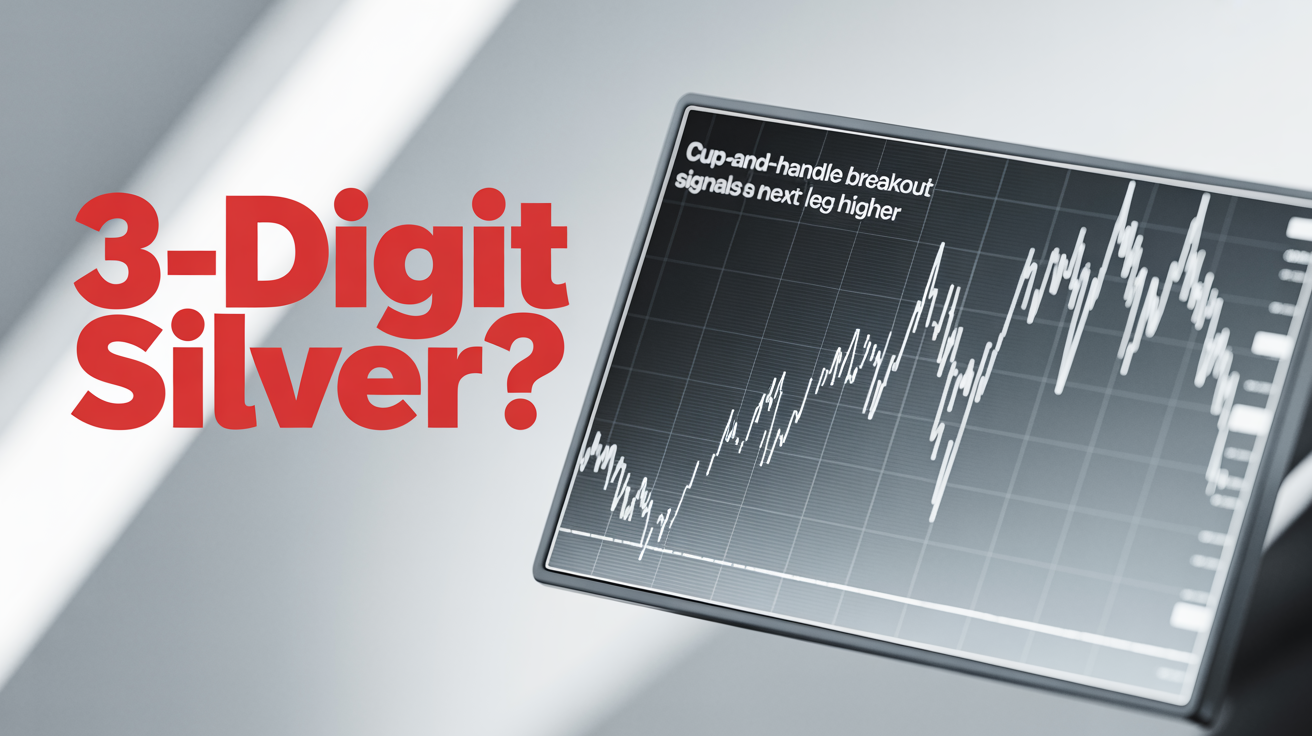
Gold has already made its statement. Silver is still clearing its throat. The chart the host sketches is familiar to long-time metal watchers: a jagged, years-long cup-and-handle pattern that has lacked the textbook symmetry of the classic breakout. Momentum stalls and zigzags have frustrated bulls, but beneath the surface, the scaffolding has been building. Clearing thirty dollars punched through a psychological line; pushing past thirty-five hardened the floor. The move over forty reframed the debate from “can silver get going?” to “what happens when it does?”
Two engines power silver, and both are rumbling. Industrial demand—from solar, electrification, electronics, and a hundred quiet applications—is steady, price insensitive over tactically relevant horizons, and now plausibly bumping up against constraints in above-ground stocks. The other engine is human emotion: the investor who cannot, or will not, chase gold at nose-bleed figures, and who sees in silver a cheaper ticket into the same protection trade. When both engines fire together, silver’s thinness cuts both ways. Rallies sprint farther than models expect, and corrections bite deeper than fear allows. But when the tape tips toward deficit conditions and inventory drawdowns, spikes in physical delivery interest can turn futures markets into logistical theaters.
That is why the show lingers on delivery data. In a year that has seen surprisingly robust physical takings in gold, September’s gold deliveries have been quiet, but silver’s have been loud. Without obsessing over a single month, the broader point is that the appetite for actual metal—not merely paper exposure—is rising in ways that line up with the story of tightening inventories, expanding industrial needs, and widening retail curiosity. The implication is not that the warehouse doors will clang shut tomorrow. It is that the marginal ounce of readily deliverable silver is more contested than it was a year ago, and price is the referee.
When crypto money walks into the mine
One of the most novel threads in the broadcast is the bridge being built between stablecoin profits and the physical world. If the largest dollar-pegged token issuer decides to diversify a slice of its cash-gushing business into equity stakes or financing for gold miners, the flows could matter. The miners are a levered play on bullion prices; in a capital-tight world, they are also price-takers on funding. A new, eager pool of non-traditional money does not just goose share prices—it can change which projects get green-lit, which reserves get developed, and how quickly marginal supply responds to price signals.
There are open questions. Will such a crypto-to-commodity capital pipeline concentrate in a handful of large names, effectively shadowing the big mining ETFs? Or will it seep into mid-tier producers and developers across jurisdictions? Could it be paired with offtake agreements, tokenized claims on output, or other hybrid structures that blend digital finance with the material economy? None of those answers are necessary to grasp the first-order point. Precious-metal miners may be on the cusp of a funding backdrop that is less dependent on the vicissitudes of traditional equity markets and more intertwined with the balance sheets of a growing, liquid, and increasingly mainstream digital dollar ecosystem.
If that thesis expands beyond gold—to copper for grid build-outs, uranium for baseload, or critical minerals—the commodity complex as a whole could experience new cycles of capital access, hype, and disappointment. The episode’s tone is cautious here; the host acknowledges that flooding a niche sector with fresh money can blow bubbles independent of fundamentals. But for investors in gold and silver, the idea that a major stablecoin issuer might become a strategic sponsor of miners is an upside catalyst that did not exist a few years ago.
The derivatives iceberg: how big is precious metal risk, really?
Now to the heart of the matter: will a silver moonshot break a bullion bank? To answer, the show turns to the Office of the Comptroller of the Currency’s quarterly survey of derivatives inside U.S. banks. The first impression is scale. Total notional amounts of derivatives at the largest dealers tower into the hundreds of trillions. Within that world, futures and options are meaningful but far smaller than the universe of swaps and bespoke contracts. And within that pyramid, commodities—of which precious metals are a subset—are a sliver compared to interest-rate exposures, foreign exchange positions, equity derivatives, and credit trades.
If you are picturing a colossus, you are not wrong. The four dominant U.S. banks named in the report shoulder the vast majority of this activity. Their derivatives books generate a non-trivial share of revenues, but even at peak, that share is a fraction of overall income across sprawling franchises that include lending, payments, wealth, and capital markets. If precious-metals derivatives sit inside the derivatives bucket as the smallest slice, then a catastrophic loss in silver or gold would have to be unimaginably large to, on its own, push a universal bank over the edge.
This is not an invitation to complacency. Leverage multiplies losses, model errors metastasize in stress, and cross-gamma relationships between markets can turn a small fire into a bigger one rapidly. But as the host frames it, the realistic systemic hazards are more likely to originate in the towering stacks of interest-rate trades, currency exposures, and credit derivatives that knit the entire dollar system together. That is both comforting and sobering. Comforting, because it implies that a run on silver alone is unlikely to detonate a balance sheet. Sobering, because the central concentrations of risk are embedded in the very plumbing of money, not in a niche metals corner.
There is another twist. For decades, precious-metal exposures were often grouped under currency headings in bank reports, obscuring the true footprint of metals. More recent reporting has improved that visibility, making it easier to compare apples to apples. Even with better disclosure, metals remain small next to the behemoths of rates and FX. If you are hoping for a silver-led bank failure to emancipate the market, the episode advises, you may be disappointed. Even a violent squeeze through fifty dollars is more likely to show up as a bad quarter than a mortal wound.
The realistic path of stress and the bailout reflex
What would it take, then, for a precious-metals move to be the straw that breaks a camel? In practice, it would probably have to be a straw riding on the back of a much larger load. Imagine an environment where interest rates lurch higher or lower dramatically, shredding the mark-to-market on swaps while liquidity vanishes in Treasuries; or where a currency shock forces sudden, massive re-hedging by global corporates and banks; or where credit spreads blow out across multiple sectors. In that melee, a bank also trapped on the wrong side of a sizeable silver short could find that position aggravating its overall stress. But the proximate cause would not be silver. It would be the broader storm.
And if the storm gathers, the historical pattern is depressingly consistent. The policy reflex is to backstop, extend, and pretend. In that world, losses in a metals book would be wrapped into a generalized rescue—a discount window surge, a liquidity facility, a waiver, a quiet floor under collateral values. The show’s conclusion is that anyone banking on a metals-only failure to reset the game misunderstands the way modern crises are managed.
What overbought means when “normal” is gone
This leaves us with the tactical puzzle the host leans into throughout the episode. On the one hand, gold’s relative strength readings and Fibonacci extensions suggest a market that has run very far, very fast. On the other, the narrative skeleton that supports those moves—debt ratios at levels historically linked with weak growth, sclerotic productivity, demographic drag, geopolitical risk, and eroded confidence in central-bank omnipotence—has not healed. If anything, each passing revision, each fragile retail quarter, and each lurch in policy expectations cements the sense that the 2000–2019 playbook is obsolete.
In such regimes, what looks overbought can stay that way. The show’s host reaches back to two prior breakpoints—2008 and 2020—as moments when gold’s technicals screamed “too hot,” only to be the early part of an even bigger repricing as the macro narrative caught up to the price. This is not a law; it is a conditional pattern. In the next few weeks, the Fed’s decision and guidance will do much to shape the path. A smaller cut than markets expect, or a hold alongside stern language, could finally give short-term sellers a pretext to press a correction toward the low-to-mid three-thousands. A larger cut, or a signal that more are imminent, could simply blow the roof off again.
Silver’s nuance is slightly different. Because it lagged, because it is lower on the relative-strength ladder, and because its bid springs from both investment and industry, it has more obvious room to run if gold’s next lurch is upward. A pullback in gold would not doom silver; it could create a brief window where silver’s relative bid persists on structural scarcity and fresh investor flows before gravity exerts itself. The most durable rallies in silver rarely travel in straight lines. They are roller coasters that still deliver you to the ridge when the ride ends.
The holiday hinge and the 2026 reckoning
One seasonal hinge remains in focus: the final quarter. If the American consumer shows up in force with cash and not just credit, the landing zone for 2025 could look softer. If households retrench, a discouraging retail season would amplify layoffs, clip investment, and concentrate political and policy pressure into the new year. The episode’s base case is that 2026 will be the year when economists and officials are forced to use starker language about recession or depression and lean into a more aggressive easing cycle. That cadence, in this analysis, pairs naturally with higher bullion prices over the medium term and a structurally weaker currency over time.
There is a simple image offered to organize the complexity: a boat, a shoreline, and a stretch of rough water between them. The pilot cannot wish away the rocks or the storm. He can only choose a course that maximizes the odds of making land. In this analogy, policymakers are the pilot, the interest-rate lever is the wheel, and the rocks are the debt ratios and growth constraints baked into the hull. Investors are the passengers who can, at least, choose whether to wear life jackets.
So, would $50 silver break a bank?
This is the headline question, and it deserves a crisp answer after all the context. The Freedom Report’s answer is that fifty-dollar silver—while dramatic, while operationally disruptive for shorts, while capable of inflicting real P&L pain—by itself is unlikely to bankrupt a major U.S. bank. The metals complex is too small a slice of overall derivatives exposure. The books are too diversified. The buffers are too practiced, and the policy reflex too fast, for a metals-specific move to be the sole precipitating cause. Could it contribute to stress in a wider storm? Yes. Would it be the origin story of the next failure? Much less likely.
That conclusion is not bearish on silver. It is, in fact, quietly bullish. If the thesis for owning silver depends on a bank’s collapse to be validated, it is brittle. If the thesis rests on tightening physical balances, resilient industrial offtake, spillover demand from a gold bull, and policy that implicitly favors hard assets in a de-financializing, de-globalizing world, it is sturdier. The former requires a crisis you cannot predict. The latter merely requires the continuation of trends already visible in data, flows, and behavior.
How to read the tape from here
If you accept the show’s framework, the next steps for an observer become less about prophecy and more about posture. The immediate variable is the Fed. Into and after the meeting, watch how front-end rates, the dollar index, and real yields react. Gold is exquisitely sensitive to the joint message those markets send about growth and policy credibility. A softer policy path with inflation still sticky lowers real yields and adds fuel to bullion. A deflationary scare that pushes nominal yields down faster than inflation expectations fall can do the same. The path that pressures gold most in the short run is one where the Fed stays hawkish, nominal yields rise, and the dollar squeezes higher. Even then, the relief could be temporary if the cost is more damage to the interest-sensitive parts of the economy and heavier stress in 2026.
Beyond the week-to-week, the signals that matter for silver are as old as the metal: inventories and use. Keep an eye on reported stocks at major hubs, on delivery interest into expirations, on refinery throughput and premiums, and on the incremental demands of electrification and solar build-out. Track how quickly any new flow of crypto-sourced capital into miners translates into actual new ounces, not just equity rallies. The lag between funding and metal is long. If money arrives faster than projects can responsibly scale, the price will do the rationing.
And remember the nature of these assets in this regime. The most powerful long-term drivers are not the daily headlines but the slow-turning gears of demography, productivity, debt dynamics, and the institutional memory of inflation. The individuals and institutions making allocation decisions in 2025 are not the same as those in 2005. They have lived through a crisis, a pandemic, a supply shock, and a policy experiment. They hold fewer illusions about the omniscience of central banks and the linearity of globalization. In that world, the bid for scarce, bearer assets with no counterparty risk is not a fad. It is a strategy.
The Freedom Report’s core message, distilled
Strip away the charts, the revisions, the delivery tallies, and the OCC tables, and what is left is a sober, deeply intuitive claim. Gold is in a secular bull market that has not finished telling its story. Silver is awakening and, because of its dual identity as an industrial metal and a monetary surrogate, has the potential to travel faster than narratives can keep up once confidence spills over. The consumer is tired. The Fed is cornered. The economy is gliding toward a period in which “stability” will be purchased with cheaper money rather than stronger fundamentals. In that environment, the old technical tripwires still matter for timing, but they do not tell you whether you are on the right side of history.
Will a sprint through fifty dollars be the day that remakes the banking system? Probably not. Will it be another marquee mile marker on a road already heading uphill for precious metals? Very likely. And if you are measuring the move not by whether it topples a bank but by whether it preserves purchasing power through a policy and growth regime that corrodes paper promises, then you are asking the better question.
The rocks are visible now. The water is shallower than it used to be. The boat is heavier. The pilot’s options are narrow. That is not a call to panic. It is a call to think in regimes, not in ticks; to respect how much has changed; and to understand why, even with an RSI screaming and a Fibonacci blazing, gold can surge and keep surging, and silver can finally remember what it feels like to run.